

YES! Summer has arrived and most of you are getting out on the water without a drysuit or even a heater shirt. I hope you find this newsletter was worth the wait and that you have a most excellent summer of foot’n!
If you want to see these newsletters in your email… SIGN UP HERE!
In this issue:
- Backward Barefoot Deepwater Start
- Letter from the ABC President
- The Barefoot Family
The Back Deep in 3D
Authored by Paul Stokes and Footer is Heather Hartwig Stokes
In this article we are going to break down the back deep for you into a step-by-step process broken down by do, don’t, and driver.
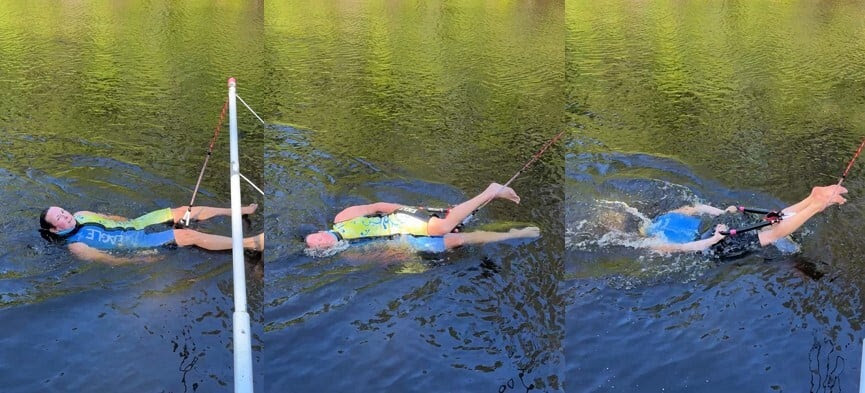
THE SETUP:
Do: Learn the back deep on a 5-foot handle off the boom set at a height that would be chest high once you are up and footing. While the boat is preparing for takeoff, stuff the handle between your legs. When ready, let the boat driver know you are rolling over. Roll over and let your trailing foot “hook” on the rope.
Don’t: Don’t try to learn long line or with an inexperienced driver.
Driver: The driver should slowly accelerate to a speed around 8-10 miles per hour. The skier should have a pocket of air to breath in while also not bouncing. If the driver is going too slow, the air pocket will collapse. If the driver is going too fast, the skier will bounce.

STEP 1: Lean how to get your feet gliding on the water, one foot at a time.
Do: Extend your arms fully, letting the pull come from your shoulders. The handle should be below your butt. Feel like you’re driving you’re your hips and chest down and keep your head up looking down the wake you are creating. While keeping one foot hooked on the rope, spread the other foot out wide and learn how to get the foot gliding on the water. Do this by spreading your leg out about 45 degrees, turning the foot out about 45 degrees, and flexing the foot up toward your knee. You must submit to the water pressure and let the water pressure take you foot. “Drag your foot”
Don’t: Don’t “Gas Pedal” or resist the water pressure with your feet and ankles. If your feet bounce, skip, dive under, or skip out, you are “gas pedaling”!!! Don’t plant your foot narrow or straight down.
Driver: Hold a slow speed steady (8-10 m.p.h.) making sure it’s fast enough for an air pocket, but not so fast that the skier is bouncing.
Summary of step 1: Once you can get one of your feet to glide, while the other is hooked on the rope, switch the feet out and learn how to glide the other foot on the water. It is natural to want to reach for the water by pointing your toes. This is the death of the back deep. Learning how to position your feet so they don’t resist the water pressure and simply glide is the secret sauce to a successful back deep. In fact, pressing against the water pressure happens sub consciously, so it takes conscious and purposeful focus to not allow this to happen. Spend as much time on step 1 as it takes to feel the foot sliding without any resistance to the water pressure. Get good at both feet going directly to a glide before moving on to the next step.
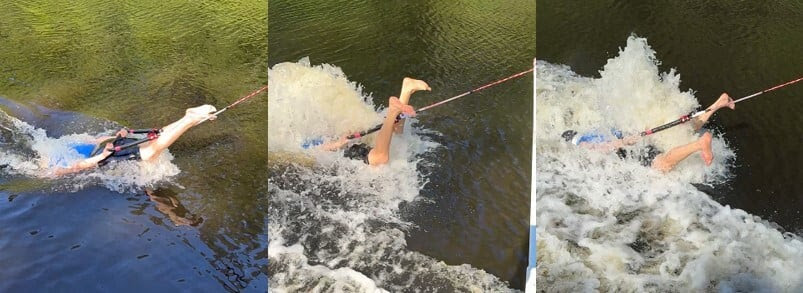
STEP 2: Learn how to ride with both feet off the rope, in the air, and be able to ride like this for as long as you want.
Do: Remember from set 1, Extend your arms fully, letting the pull come from your shoulders. The handle should be below your butt. Feel like you’re driving your hips and chest down and keep your head up looking down the wake you are creating. A common mistake is to have the handle pulled up above your butt with bent arms. Proper body position involves driving your hips and chest down with a slight arch throughout the upper body. Think of a banana…
Don’t: Don’t try to put your feet on the water, pull on the handle, or have a loose body. Also, don’t hang on if you lose your pocket of air.
Driver: Hold a slow speed steady making sure it’s fast enough for an air pocket, but not so fast that the skier is bouncing. Typically, the water will be breaking at the hips of the footer. If the footer starts to bounce, roll the throttle back a little until the footer starts to drag a little, which will stop the bouncing. Caution though, if you slow down too much, the air pocket will collapse. This is a learning process for the driver and the footer to sync up on this step.
Summary of step 2: As the boat takes off, you’ll want to take your feet of the rope relatively quickly. Think of your feet as the bow of a boat, they will rise and then you will plane off. Ideally you want to take your feet off the rope at the top of the “bow rise”. If you wait too long, it can make it tougher. Spending time getting comfortable on this step will give you the ability to focus on a proper plant, step 3.

STEP 3: Plant both feet and learn how to glide with both feet in the water while sliding on your chest.
Do: Start with a solid step 1 and 2! Spread your legs about two times shoulder width or about 45 degrees each. Turn your feet out about 45 degrees. Set both feet on the water at the same town. Let the water pressure take the foot, dragging your foot from the heal. Continue letting the boat pull you through your relaxed straight arms. As your driver adds some speed, pick your hips up off the water a little. You should be able to cruise on your chest and feet smoothly all the way down the run. Maintain staying even with your feet and arms. You do this by not fighting the boat or the water pressure. Let the boat pull through the shoulders and let the water pressure take your foot.
Don’t: Don’t rush. Don’t try to stand up. Don’t pull on your arms. Don’t resist in your feet.
Driver: Once the footer has established both feet on the water gliding, slowly accelerate 5-10 miles per hour, holding steady around 20 miles per hour.
Summary of step 3: Once this step is mastered, you should be able to ride as long as you want, sliding on your chest, with your feet spread out, and sliding smoothly across the water. Your arms will be relaxed, your hips will be pouched up off the water, and your feet will be cruising evenly. If your feet bounce, pulse, skip, or dive, you are resisting the water pressure with your feet and ankles (and maybe arms). You would need to get better at step 1.

STEP 4: Fold and Get up!
Do: Two things help you get up to back barefoot position, folding and getting your feet deeper in the water. Folding is how we describe getting your butt up in the air while pressing your chest down. You want to have a slight arch in your back as you are pressing down your chest. Getting your feet deeper in the water is accomplished by squeezing your legs together, turning your feet down in the water (from 45 degrees to 90 degrees), and driving your feet down into the water. Put about 50% of your energy into folding and 50% of your energy getting your deeper in the water. Once your chest comes off the water, look for the horizon and bend your knees.
Don’t: Don’t round your back and press your shoulders down. Don’t pull on the handle. Don’t press against the water pressure with your feet. Don’t rush. Don’t fold too much, doing so can put you in a vulnerable position when you get up.
Driver: After the footer has their feet solidly sliding across the water, moderately acceleration up to speed. You don’t need to floor it. If the footer isn’t up, by the time you reach 30-33 miles per hour, feather back the acceleration. Once they get their chest off the water, you can add acceleration back to their cruising speed.
Summary step 4: It is natural to want to reach for the water by pointing your toes and resist throughout the start. This is the one thing that kills the back deep. Learning how to position your feet so they don’t resist the water pressure and simply glide is the secret sauce to a successful back deep. In fact, pressing against the water pressure happens sub consciously and it takes conscious and purposeful action to not allow this to happen. Spend as much time on step 1 as it takes to feel the foot sliding without any resistance to the water pressure. You do need water pressure to get up, but you get the water pressure by squeezing your legs together, turning your feet down, and driving your feet deeper in the water (WITHOUT PUSHING AGAINST THE WATER PRESSURE!!!)
STEP 5: Establish solid back barefoot position.
Do: Stay broken at the waist but make sure your head and shoulders are up. Keep your eyes on the horizon. Push your butt out to the handle. Keep a slight bend in your knees. Keep your feet flat and relaxed on the water.
Don’t: Don’t break at the waist too much. If your butt and shoulders are at the same level, basically like a 90-degree angle, you lose leverage, and your feet will wash under you too much. Don’t pull in on your arms and “chicken wing” your elbows. Don’t flex your feet to ride up on your toes. Don’t keep your feet wide and turned out. Don’t bend your knees too much. Yes, good knee bend, but don’t overdo it.
Driver: Hold a consistent speed and straight line. Speeds can be slow, definitely slower than forwards. Smaller footers as slow as 26-28mph. Most in the 32-34 mph is plenty.
Summary step 5: The goal is gliding while maintaining leverage on the boat. Relaxed flat feet and ankles is the key to backwards, just like the foot under a bent knee is the key forwards. You want the pull of the boat to come through your shoulders. Have a slight arch through your back. Have your head and shoulders up. Always have your butt and handle together. Keep a good knee bend.
Longline is the same technique, it just takes more patience. It also feels different with more turbulence while on your chest. Stick with these steps, have some patience, and you will have success longline.
Message from the American Barefoot Club
Teri Larson Jones – ABC President
Greetings, Barefoot Nation:
The 2025 season is underway! I hope all of you are getting on the water!
A couple things as we get rolling this year:
First, if you plan to compete, and want to be included in the standings list, you’ll need an IWWF license. Please check out my Facebook post from April 4th to access instructions about how to purchase your license. (Paul, you can add my PDF here if you want to so they don’t have to go to Facebook)
Second, every year at the US Nationals, the ABC hosts an Annual General Membership meeting where we address questions and ideas from our members. This year, I’d like to field your questions, ideas, and concerns before our meeting so the board can prepare ahead of time. Please reach out to me, or to your Regional Directors, with topics you want to discuss at the 2025 meeting to be held in Auburndale, Florida. Feel free to submit your thoughts even if you cannot attend Nationals.
On a final and sad note, the barefoot community mourns the loss of Kevin Spada who passed away unexpectedly in April. Kevin came into our community from the world of Olympic level ice skating, and brought his athleticism and amazing sportsmanship along with him. We will miss him dearly, and are thankful for the time we had with him.

The Barefoot Family
Barefoot waterskiing isn’t just a sport, it’s a full-body adrenaline rush, a test of grit, and a gateway to a lifelong community. For those who’ve experienced the thrill of skimming across the water at 40+ miles per hour with nothing but the soles of their feet, it’s more than just a hobby. It’s a lifestyle.
Barefoot waterskiing is a niche sport, and that’s part of its charm. It’s not something you stumble into; it finds you. Whether you’re introduced by a friend, a family member, or a chance encounter at a lake, once you’re in, you’re hooked.
Because it’s so specialized, footers often travel far and wide to find others who share their passion. And that’s where the real magic happens.
Ask any footer, what keeps them coming back, and they’ll tell you: the people. The barefooting community is one of the most tight-knit, supportive, and welcoming groups you’ll ever meet. It’s a sport where competitors cheer each other on, where veterans mentor newcomers, and where lifelong friendships are forged on the dock and in the boat.
From local clinics to international tournaments, footers show up for each other. They share tips, gear, and stories. They celebrate each other’s victories and pick each other up after the falls. It’s not uncommon for footers to become like family—traveling together, training together, and growing together.
What starts as a summer thrill often becomes a lifelong journey. Many footers stay involved in the sport for decades, passing down their love for it to their kids and grandkids. It’s not just about skiing, it’s about belonging.
In barefoot waterskiing, you don’t just find a sport. You find your people.
Resources
2025 Tournament Schedule Click Here
Your First Tournament 101 Click Here
ABC YouTube Click Here
ABC Website Click Here
International Info Click Here
World Master Barefoot Championships Click Here
 American Barefoot Club